
Introduction
If you’re creating content with AI, you’re not alone. In a recent survey by the American Marketing Society, nearly 90% of marketers reported using generative AI (GenAI) tools at work, with 71% using them at least once a week and almost 20% relying on AI daily .
The reasons are compelling. According to Bain and Company, early adopters have seen content creation time drop by 30–50% and campaign time-to-market cut in half thanks to AI-driven efficiencies.
However, you have probably also seen your work, your LinkedIn, and other platforms proliferate with content over recent weeks. So, if you are creating content with AI, the first thing you have to ask yourself… and you have to ask this in any content creation endeavour: why?
AI Content Goals & Process
What are you creating? Who is it for, and why do they need it? AI is already flooding the world with content. Are you adding to that? Or are you creating something meaningful? If you are just creating noise (aka AI slop), then that won't help you or your brand. In a DoubleVerify trend report last year, 54% of advertising leaders stated that they believe GenAI is significantly harming media quality.
Once you know what content you are creating, then you have to look at why you are using AI. So step back again and set some ground rules.
What exactly are you hoping to achieve with AI in your content workflow:
Save time on first drafts?
Increase content volume?
Personalise messaging?
All of the above?
A team focused on thought leadership and insights might use AI only for research and outlining, whereas an e-commerce brand looking to scale product descriptions could lean on AI for bulk drafting.
The guiding principle here is to let your strategy dictate the tool and not vice versa.
Use the 4Ws + H framework below to define your content strategy.
Only then ask: “Where could AI actually help us execute this?"
4Ws + H
Who is it for?
What is it about?
When will it be used?
Why is it important?
How should it be delivered?
To formalise this further, you should consider putting in place a company-wide AI Policy.
Define your activity
When dealing with AI and content, it is vital that you define that activity for yourself as much as anybody else. People often say, 'AI wrote this blog,’ but they don't mention all the steps where a human iterated, edited and overwrote the AI.
So here are a few different categories of AI usage and their associated risks to help you define and evaluate your activity. Most legitimate AI use will doubtless come under the heading AI-Assisted Content.
AI Content activity
| AI Content Activity | Definition | Human Involvement | Risks | |
|---|---|---|---|---|
| Fully AI-generated content (No human in the loop) | Content produced by an LLM and published with no human editing, no fact-checking, no review. | None | Extreme risk of plagiarism, hallucinated facts, harmful stereotypes, misinformation, legal liability, and reputational damage. Should never be published in any professional context. | |
| Lightly Guided AI Content | The AI output is based on refined or repeated prompting, but still published without editing or critical review. | Prompt iteration only | Medium to high risk of factual error, tone inconsistency, or ethical issues; lacks contextual judgement and brand alignment. | |
| AI-Drafted, Human-Touched Content | AI provides a draft which is lightly edited (e.g. for grammar, tone, or structure), but the majority of content remains unchanged. | Low to Medium | Risks remain around factual accuracy, subtle bias, or tone misalignment, particularly if the review is superficial. | |
| AI-Assisted Content | AI creates a first draft, which is then fact-checked and structurally revised by a human. | High | Lower risk with appropriate human oversight. This is useful for increased efficiency when paired with expertise and editorial judgment. | |
| Human-Crafted, AI-Enhanced Content | Human-written content that uses AI only for supportive tasks (grammar, rephrasing, structure, tone, or SEO). | Very High | Low risk: AI is used like any other productivity tool; primary authorship and control remain with the human creator. | |
| AI-Powered Research Support | AI is used only for ideation, outlining, summarising, or sourcing reference points, but not for writing any actual content. | Full Human Authorship | Very low risk: AI informs thinking but plays no generative role in the final content. Equivalent to using a search engine or research assistant. |
Ethical and Brand Considerations
By assessing the above levels, marketers can decide what degree of AI involvement they are comfortable with. For most, the sweet spot will be the last three listed above. Using AI as an assistant or a drafting aid, that is always backed up by human judgment and oversight.
The examples where AI runs largely on autopilot, are inherently risky and should be given a wide berth.
For some cautionary examples in recent years, professional content providers have been seduced by the myth that AI is capable of creating content unsupervised:
Gizmodo created a list of Star Wars movies in chronological order that was not in chronological order.
CNET found errors in more than half of its generated content.
Futurism accused Sports Illustrated of generating AI content, which was then removed. A short while later, the CEO was also removed.
When it comes to content, Google often takes the role of the adult in the room, and in terms of SEO, says this about AI content:
“If you see AI as an essential way to help you produce content that is helpful and original, it might be useful to consider. If you see AI as an inexpensive, easy way to game search engine rankings, then no.”
Of course, in terms of gaming search engine rankings, creating content at scale is one such way. And by it’s nature, content produced at scale is costly to police.
Here’s AI content run through the Fast/Cheap/Good metric
The AI Content Triangle
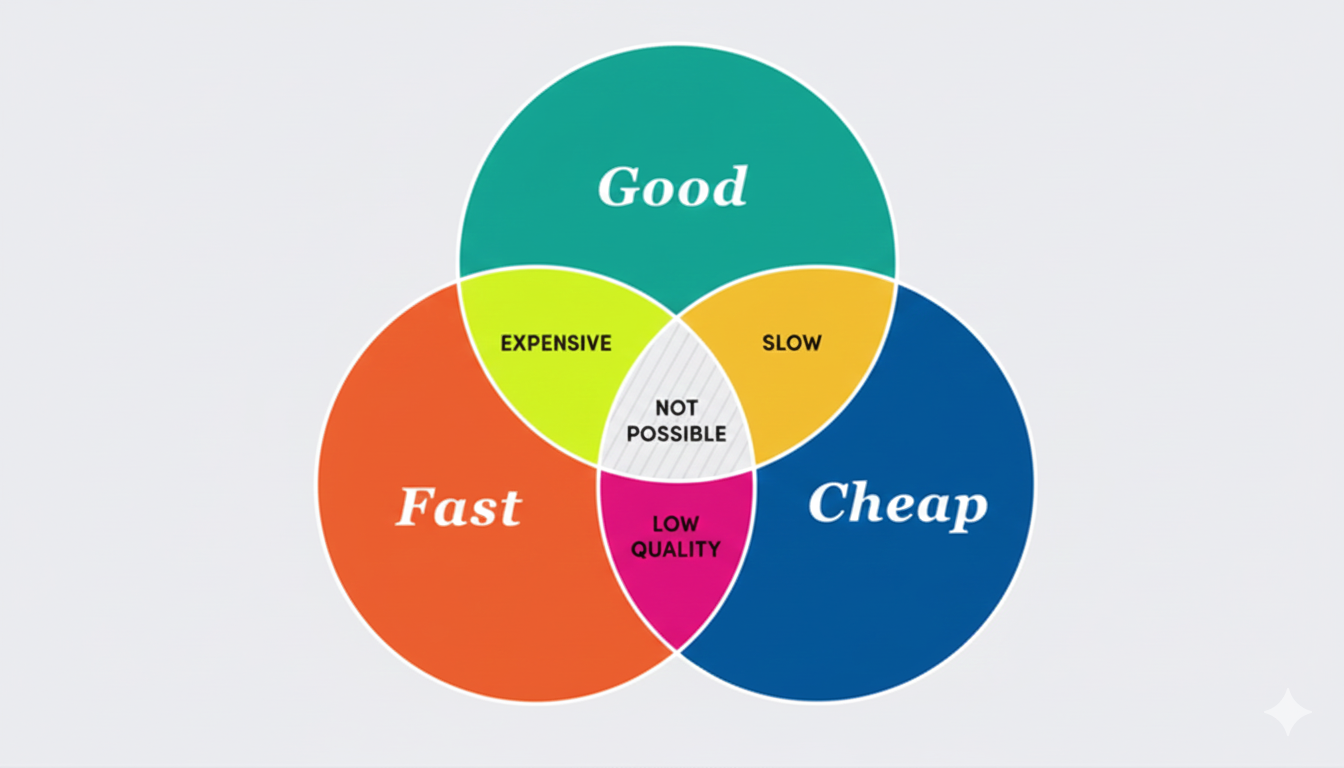
Fast + Cheap = Not Safe/Ethical
Risk of hallucination, bias, plagiarism and reputational damage. |
Fast + Safe = Not Cheap
Requires editorial teams, compliance checks, and fact verification. Higher cost in time and resources. |
Cheap + Safe = Not Fast
Slower turnaround due to manual oversight and revision cycles, but affordable with internal labour or phased workflows. But still, faster than no AI.
Cheap + Safe + Fast = Not possible
The Ethics of AI-Assisted Content
Let’s take a look at the foundations of what we want from our AI-assisted content:
Accuracy & Reliability
AI-generated content must be factually correct and verifiable.Fairness & Inclusivity
Content should be free from bias, stereotypes, and exclusionary language.Respect & Sensitivity
AI should avoid offensive language and culturally insensitive narratives.●Transparency
Readers should be aware when AI has been used to create content.Authenticity
AI should support, not replace, human creativity and brand voice.
To insist on the above, which is foundational… you need:
A human final check
Excellent and trusted research or expertise
Honesty with your readers/audience
A governance policy
And to have the above, you need to put in place an accountability-based process. Without this you cannot be sure of the content you are publishing.
Rolling out AI tools successfully is as much about culture as it is about compliance. Teams need space to explore and confidence that trying new approaches is encouraged - think of this as encouraging AI experimentation.
Three principles to embed in your organisation:
1. Encourage curiosity.
Allocate time to test tools and discuss findings. Curiosity needs space - without it, experimentation doesn’t happen.
2. Embrace failure.
Not every use of AI will lead to a live asset, and that’s fine. The aim is to learn what works, not to polish every experiment into publishable content. A great tip is to share failures as well as successes so everyone learns from them.
3. Establish clear guardrails.
People need clarity around what’s allowed. This includes acceptable tools, how personal or customer data can be used, and what sign-off looks like when AI is involved. Policies should empower rather than restrict.
Examples of how to encourage adoption at a team level:
AI Exploration Groups
Cross-functional teams that trial tools and share useful prompts or processes.
AI Advocates
Individuals who document effective use cases and support others in getting started.Juniors as leader
Often, newer team members experiment more instinctively and can be a source of new ideas or efficiencies. They are also likely to have more spare time, and it can be an excellent growth opportunity for them.
AI-Assisted Content Opportunities
Hopefully there are enough cautionary tales above to assure readers of the risks of AI, but what about the benefits? Bearing in mind the Global AI Powered Content Creation Market was valued at USD 2.3 Billion in 2024 and is expected to reach USD 7.9 Billion in 2033 what can you do with AI?
The following is a list of use cases and processes to help teams safely and effectively apply AI in content operations without falling into the trap of “set and forget.”
NB This is neither exhaustive or a strict set… you could easily add more use cases or mix and match to suit your specific needs.
1. Idea Generation & Content Brainstorming
Goal: Avoid blank page syndrome.
Use Case: Brainstorm blog topics or angles for a campaign/blog/social post etc.
Process: Share recently published content, discussions or ideas with your LLM.
Sample prompt:
“Based on our recent whitepaper on [topic], suggest 10 new article titles for CMOs. Keep them short, clever, and insight-driven.” Prompt again for first-paragraph drafts, angles, and call-to-action ideas.
Human review: Combine with audience insight to narrow down the focus. Always validate any generated ideas, AI can suggest content that sounds on-brand but ultimately adds nothing.
Useful for starting the conversation, and potentially uncovering new combinations of thought.
2. Content Expansion
Goal: Use AI to help you add depth to early-stage human work.
Use Case: You've drafted a summary, now build it into a 1,200-word article.
Process: Copy and paste a human-drafted outline or paragraph into an LLM.
Sample prompt:
“Expand this summary into a complete blog post with examples, citations, and links to authoritative sources. Target audience: X.”
Human review: Edit for brand tone, compliance, and quality control. Review and rewrite sections with shallow or generic phrasing. Fact-check every claim. Flag unverified references.
This is great for scaling up content from strong editorial control and potentially useful at pointing out new angles to develop.
3. SEO Optimisation & Structure Support
Goal: Improve metadata, structure, and ranking signals.
Use Case: Optimise an article for organic discovery.
Process: Copy and paste an existing blog or article into an LLM.
Sample prompt:
"Generate an SEO-optimised meta description for this content and list five high-volume keywords. Suggest a better H1 and H2 structure. [Ideally, add in your own (or widely accepted) rules about SEO structure and keyword placement].”
Human review: Edit for brand tone, compliance, quality control, and SEO best practice.
An efficient way to boost discoverability without changing your core content.
4. Tone of Voice Rewriting
Goal: Adapt content tone for different platforms or audiences.
Use Case: Take a technical whitepaper and adapt it for sales enablement.
Process: Copy and paste a section of content into an LLM.
Sample prompt:
"Rewrite this section in a confident, clear tone suitable for B2B decision-makers. Keep the facts, remove jargon and only use the inputted data. Do not add any content.”
Create email pitch versions, summaries, or presentation snippets.
Human review: edit for brand tone, compliance, and quality control.
Useful for TOV compliance but also a simple way to keep your TOV front of mind.
5. Multilingual Drafting & Localisation Support
Goal: Scale content for global teams.
Use Case: Turn a UK campaign into localised versions for use in different territories.
Process: Copy and paste an existing blog or article into an LLM.
Sample prompt:
"Translate and localise this for a professional audience in [x country]. Use business-appropriate language and cultural sensitivity."
Human review: Route through a native-speaking reviewer or local marketing team. Never rely on AI for cultural nuance or idioms without human QA.
With the right governance, oversight, and strategy, this is potentially a very efficient way to scale your content.
6. Content Repurposing
Goal: Maximise the value of existing, human-written content.
Use Case: Traditional content planning: turn a long-form blog into multiple content types.
Process: Input the full blog into AI.
Sample prompt:
“Break this blog into three social media threads for a LinkedIn carousel, X and an infographic using a conversational but expert tone. Use only the existing content inputted—do not add anything. ”
Create: Tweets, carousel copy, infographics etc.
Human review: Edit for brand tone, compliance, and quality control.
This approach offers a high return and low risk when good quality, human content is the starting point.
7. Audience Personalisation
Goal: Create targeted variations of a message for different segments.
Use Case: Email requesting product reviews.
Process: Write the core message yourself. If using AI for personalisation, only input
datasets into tools that operate within your organisation's secure environment or are
explicitly confirmed as GDPR-compliant and do not retain or reuse inputted data. Avoid
inputting personally identifiable information (PII) into public or non-compliant LLMs.
Sample prompt:
“Using only the provided GDPR-compliant dataset processed in accordance with privacy regulations, generate short, personalised email intros. Match the following tone: warm, grateful, conversational. Each intro should address the recipient by first name from the dataset. Append the following text to the end of the introduction (and do not alter it): [insert pre-written content].
Merge with the human-written body for a scalable 1:1 feel.
Human review: Edit for brand tone, compliance, and quality control. Check names have been ported across without hallucination.
This requires data sensitivity and compliance with privacy rules (e.g., GDPR) but could offer the opportunity to efficiently connect with your audience.
8. Content Summarisation & Briefing
Goal: Turn complex documents into readable summaries.
Use Case: Summarise a 40-page PDF for a client-facing briefing.
Process: Copy and paste an existing blog/white paper/study/meeting notes etc into an LLM.
Sample prompt:
“Summarise this for an exec briefing in under 300 words, including key recommendations.”
Use AI to help create TL;DRs or slide notes. Ensure they are correct.
Human review: Edit for brand tone, compliance, and quality control. There must also be a safeguard to ensure knowledge is not lost or misconstrued.
This offers the opportunity to reduce cognitive load, which is ideal for fast-moving teams.
9. Compliance & Risk Pre-Screening
Goal: Catch potential red flags before publishing.
Use Case: Check sensitive content for any issues (legal, health, financial).
Process: Copy and paste draft content into an LLM.
Sample prompt:
“Review this for misinformation, unqualified health claims, or risky advice.”
Human review: Edit for brand tone, compliance, and quality control. Conduct human compliance review with legal or policy owner. Pair with bias checker or tools listed below under Fact-Checking & Bias Detection
This adds a layer of defence. Having any process to check content is better than none, but it can never replace the final approval authority of the human accountable for the content.
10. Rapid A/B Testing
Goal: Quickly compare different versions of a message.
Use Case: Landing page variations or email subject lines.
Process: Copy and paste some draft content into an LLM.
Sample Prompt:
“Generate five emotionally varied headlines for this landing page focused on time-saving for HR leaders.”
Human review: Edit for brand tone, compliance, and quality control. Monitor results and iterate based on real data.
This accelerates creative testing cycles while keeping human intent at the core.
AI Marketing Asset Opportunities
AI can also support a wide range of marketing assets. This quick list shows where it can boost speed and scale, always with human oversight and brand control.
GTM Plans
Structure competitive research, format strategic docs, and draft segment outlines.
Buyer Personas
Generate draft personas from behavioural data and prompt-based segmentation.
Messaging Frameworks|
Create headline/tagline variations and structure positioning narratives.
Blog Posts
Draft outlines, expand summaries, suggest SEO keywords and structure.
SEO Pages
Cluster keywords, improve metadata, and enhance page hierarchy.
Infographics
Draft copy blocks or suggest layout logic for data-led visuals.
Social Posts
Turn long-form content into platform-specific copy variants.
Email Campaigns
Generate intro lines, variants for CTAs, and subject line options.
Case Studies
Organise interview inputs into a narrative structure highlighting benefits and metrics.
Product Sheets
Summarise long specs into scannable formats; bullet point the highlights.
Sales Battlecards
Draft competitive Q&A sections based on public insights; format key differentiators.
Customer Newsletters – Personalise intros and summarise key content blocks for specific segments.
Webinar Scripts
Outline structure, generate Q&A prompts, and adapt into follow-up blog copy.
Landing Pages
Suggest emotional variants for CTAs and test headline options.
Campaign Dashboards
Summarise performance data into insights or narrative slides.
Internal Training Docs
Convert SOPs or onboarding material into simpler formats or quiz questions.
Content Calendars
Suggest publishing timelines based on topic clusters or market trends.
Perfecting Your Prompt
Using AI effectively doesn’t require special phrases. It requires structured thinking and there are some tips and tricks to using it well. Think of AI as a helpful but inexperienced junior. You need to brief it clearly, provide examples, and give feedback.
Here are six prompting techniques that help AI tools like ChatGPT produce better results for marketing work:
1. Use plain language and explain any jargon.
Don’t assume the tool understands marketing terms or internal shorthand. If you wouldn’t say it to a new team member without explaining it, clarify it in the prompt.
2. Include ‘Act as...’ to set the role.
For example: Act as a content strategist for a B2B SaaS company. This helps the model align tone, structure and priorities. Extra tip - this can be used to test out marketing content for personas: Act as a senior HR director, what does this LinkedIn post make you think?
3. Specify the output format.
Tell it exactly how to present the output - e.g. as a blog outline, a comparison table, three email subject lines, or a LinkedIn carousel. Extra tip - this can be used to get things in the exact format needed, eg Format so I can copy directly to [Google Sheets, a word doc, etc]
4. Provide relevant context.
Include audience, goals, tone of voice, and key messages. For example: We’re targeting product managers with limited technical knowledge. The tone should be confident but not overly technical. This can include uploading any brand guidelines or assets.
5. Give an example.
One clear example can shape the output far more effectively than a list of adjectives. This is especially helpful when generating content variations or adapting tone. For example, Here are three of our previous Facebook posts, create 10 more with the theme X.
6. Give feedback to get what you actually want.
You wouldn’t expect an intern to get it right first time. Be specific about what’s not working, and ask the tool to refine, rewrite, or try again with your notes in mind. For example, Make the tone less formal, add in more examples. Change the ending to be more positive and have a CTA.
Resources
These tools, guides, and frameworks will help you scale content with integrity, not at the cost of it.
1. Fact-Checking & Bias Detection
Consensus
An AI-powered tool that references academic literature (good for research validation).
Winston AI
Detects AI-generated content and flags potential risks.
Copyleaks AI Detector
Check originality, bias, and potential AI hallucinations.
2. AI Prompting Frameworks
OpenAI’s Prompt Engineering Guide
This guide offers strategies for crafting clear and effective prompts to achieve trustworthy outputs with OpenAI's models.
Prompt Engineering Guide by DAIR.AI
A comprehensive resource covering advanced prompting techniques, learning guides, and model-specific prompting strategies.
Microsoft's Prompt Engineering Techniques
Offers scenario-specific guidance for prompt engineering, particularly in the context of Azure OpenAI services.
Anthropic's Interactive Prompt Engineering Tutorial
An interactive tutorial hosted on GitHub, providing hands-on experience with prompt engineering techniques.
3. Glossary
MIT’s guide to generative AI basics
Ethics, Transparency & Governance
1. Policy & Standards
Google’s Guidance on Helpful Content
Google’s SEO-friendly framing of what’s acceptable (hint: human oversight is key).
EU AI Act Summary
Overview of current and upcoming legislation for content use in the EU.
2. Ethics Frameworks
AI Ethics Guidelines Global Inventory – AlgorithmWatch
Tracks ethical principles from governments, corporations, and academia.
Partnership on AI
Partnership on AI is an independent organisation setting standards for responsible AI development.
Templates & Checklists
1. AI Usage Declaration Template (Internal Comms / Disclosure) Canva Template Example
Edit and brand your own AI usage disclosure or internal content policy.
2. Responsible AI Content Checklist
Build your own or adapt from:
The Content Authenticity Initiative
AI Content Ethics & Risk Assessment Quiz & Worksheet
Ensure this quiz and worksheet are copy and pasted to the front of all your AI-generated/assisted content, and the quiz is answered by the person submitting the content for publishing.
AI Content Ethics & Risk Assessment Quiz
Use this quiz before publishing any AI-generated or AI-assisted content.
Mark each statement as YES or NO:
Accuracy: Have all facts and figures generated by AI been independently verified?
Transparency: Have you considered the need for indicating to your readership if and where AI was involved in creating this content?
Bias & Fairness: Has the content been checked thoroughly to ensure it is free of biases, stereotypes, or offensive language?
Legal Compliance: Does this content adhere fully to relevant data privacy laws and copyright?
Brand Alignment: Does the content clearly align with your established brand voice, values, and messaging guidelines?
Reputational Risk: Has this content been reviewed for potential reputational risks, misunderstanding, or misinterpretation?
Human Oversight: Has a human reviewed and edited this AI content extensively (beyond grammar and minor adjustments)?
Conclusion: Rise Above The Noise
AI is no longer a futuristic concept for marketers. It’s here, now, embedded in the tools we use every day. The overarching takeaway is about balance. We all stand to gain a powerful advantage by embracing AI, but that advantage is only realised when we pair the technology with human judgment and insight, clear goals, and strong standards.
In practical terms, that means being strategic and selective: use AI where it adds value (brainstorms, drafts, and personalisation at scale), but don’t use it as a replacement for the human elements of great content (original insight, empathy, and trust-building).
It means speeding up routine tasks so you can spend more time on strategy and creativity. It means empowering your team with tools and training them to use those tools critically. It’s exciting to think that with AI, a lean content team can produce the volume and diversity of content that used to require an army, but quantity must not (and cannot) trump quality. The internet is filling up with AI-generated content, much of it mediocre. The great opportunity is that your brand can rise above that noise by applying rigour and care in creating great content that connects with your audience